

FAQ
FAQ




The 50–200 TPD range is where pyrolysis moves from pilot-scale trials to genuine commercial operation. Below this band, most installations are batch or semi-continuous units aimed at testing, small-to-medium throughput, or markets where labour is cheap and manual feeding is still economical. From 50 TPD upwards, the economics change: continuous feeding, stable output quality, predictable energy and labour costs, and the ability to run profitably around the clock. At DOING ECO, configuration proposals for this capacity band always start from the same module logic — because the equipment list determines both the capital cost and whether the plant can actually hit its rated daily tonnage.
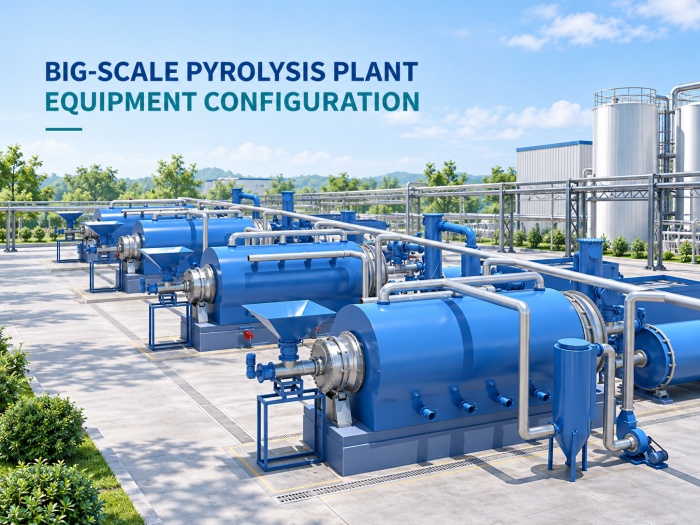 50-200TPD pyrolysis plant equipment configuration
Whether the feedstock is waste tyres, waste plastics or oil sludge, a big industrial scale pyrolysis plant in this capacity band is built from the same core modules. This is the module breakdown DOING ECO's engineering team uses as the baseline for every configuration proposal:
| Module | Main Components | Function |
|---|---|---|
| Pre-treatment | Tyre shredding & steel wire extraction; plastic crushing & sorting; oil sludge centrifugal dewatering & sand removal; belt/screw feeding, sealed lock-type feeders | Reduces feedstock to required size, removes water and impurities, and ensures stable, sealed feeding |
| Reactor section | Horizontal rotary pyrolysis reactor(s), burner/heating system, multi-stage sealing devices | Oxygen-free thermal decomposition into oil gas, carbon black/sand and steel wire |
| Oil & gas condensation | Multi-stage condensers, oil-water separation, non-condensable gas recovery | Converts oil gas into liquid pyrolysis oil; recovered gas returns to furnace as fuel |
| Discharge system | Continuous or batch slag/carbon discharge, water-sealed cooling, enclosed conveying | Safe discharge while preventing air ingress and dust emission |
| Environmental system | Desulfurisation, denitrification, dedusting, deodorisation, chimney | Meets local emission requirements |
| Control system | PLC centralized control, remote monitoring, interlock protection | Reduces manual labour and improves operational stability and safety |
| Optional: refining line | Catalytic distillation / dewaxing, fractionation, cooling | Upgrades pyrolysis oil toward diesel-grade fuel for generators, boilers or resale |
Two points our engineers stress at the quotation stage: pre-treatment and environmental modules are the ones most often under-budgeted; and oil sludge lines must include dewatering up front, otherwise moisture content directly reduces throughput and raises fuel consumption per tonne.
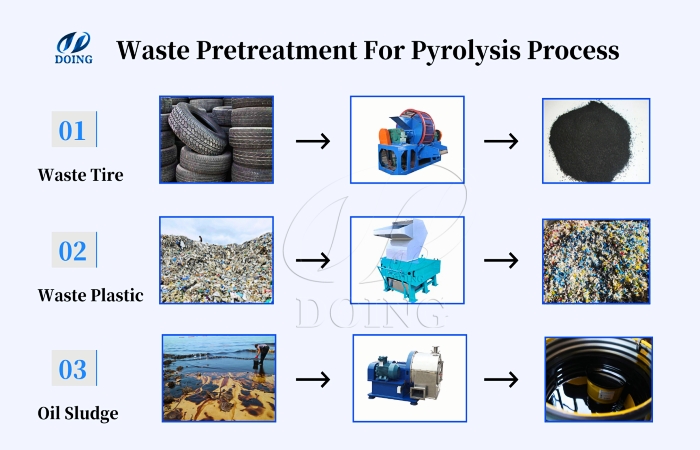 Pretreatment process of pyrolysis line
Single Pyrolysis Lines vs Parallel Pyrolysis Lines. For 50 TPD, a single dedicated pyrolysis line is usually the most economical choice. At 100 TPD and above, two parallel 50 TPD pyrolysis oil production lines are generally preferable to one oversized unit: one reactor can undergo scheduled maintenance while the other keeps running, protecting annual output and avoiding a total shutdown. The trade-off is a slightly larger footprint and higher investment. At 150–200 TPD, cluster layouts (multiple reactors sharing one condensation and environmental system) become the standard approach — this is the arrangement DOING ECO typically recommends for investors scaling beyond 100 TPD.
Pyrolysis Reactor Quantity. Capacity in this band is added in parallel rather than by enlarging reactor diameter indefinitely — heat transfer efficiency and material residence time set practical limits. As a rough reference, a 50 TPD line typically uses one full-continuous reactor or 2–3 semi-continuous pyrolysis units; a 100 TPD layout commonly uses two full-continuous reactors in parallel or 4–6 smaller units. Final counts depend on feedstock type, moisture content and planned operating hours, and must be confirmed against actual model data.
Pyrolysis Oil Refining Line. Decide this by your sales channel, not by what equipment is available. Raw pyrolysis oil sells to industrial boilers and furnaces at a lower price but with minimal upgrading cost. If your target market is diesel generator sets, construction machinery or local fuel resale, a pyrolysis oil refining line becomes necessary — unrefined oil's flash point, viscosity and sulphur content do not meet generator specifications. Where no reliable diesel buyer exists locally, it is wiser to start with the pyrolysis line alone and reserve space for a future refining stage.
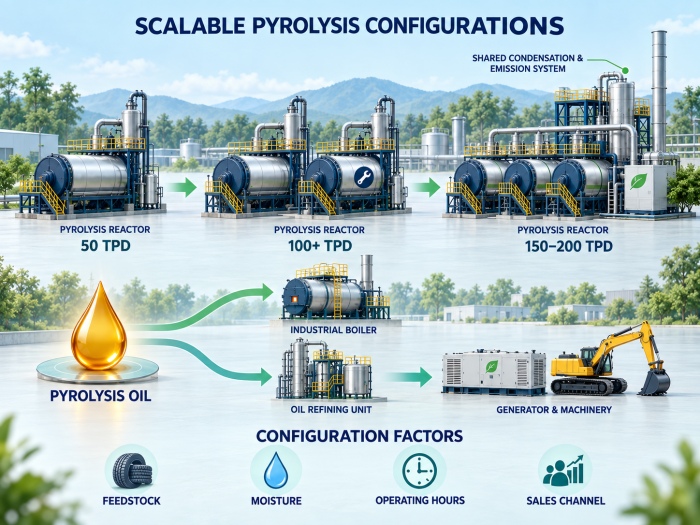 Pyrolysis plant configuration factor
The reference projects below are DOING ECO's own installed projects, not catalogue examples. Henan Doing Environmental Protection Technology Co., Ltd (DOING ECO) has delivered pyrolysis and oil-refining projects across Africa, South America, Europe and Southeast Asia, with registered subsidiaries and resident engineers in key markets such as Nigeria. Because these configurations come from actual operating data rather than theoretical calculation, the annual throughput figures shown are achievable running tonnage, not just nameplate capacity.
Chongqing, China | 100 TPD waste tyre full-continuous pyrolysis line
Capacity: 100 TPD (2 × DY-C50 full-continuous pyrolysis reactors in parallel) / approx. 36,000 t/a
Configuration: fully automatic continuous feeding, horizontal rotary continuous cracking furnace, multi-stage oil & gas condensation, enclosed water-cooled continuous slag discharge, carbon black deep-processing system, tail gas recycled to furnace, complete desulfurisation-denitrification-dedusting, PLC remote automatic control
Note: A domestic benchmark for industrial-scale continuous tyre pyrolysis, running stably for over four years and producing fuel oil, carbon black and steel wire at commercial volume.
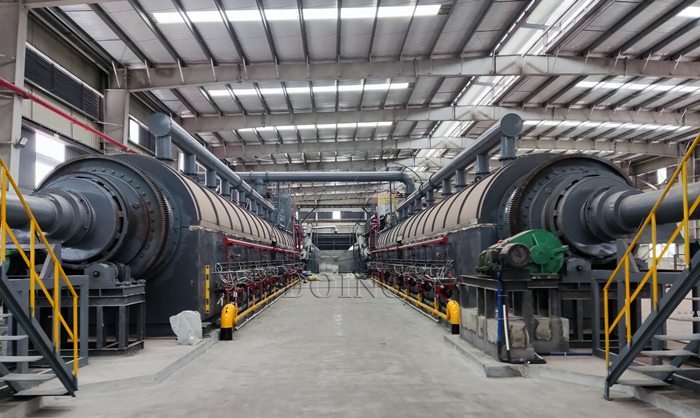 100TPD fully continuous pyrolysis project in China
Xinjiang, China | 60 TPD waste plastic semi-continuous pyrolysis line
Capacity: 60 TPD (4 × DY-15TPD units in parallel) / approx. 21,600 t/a
Configuration: plastic-specific crushing system, horizontal cracking kettles, oil & gas catalytic conditioning plus dewaxing, multi-stage condensation, negative-pressure explosion protection, flue gas desulfurisation and odour removal, PLC centralized control
Note: Designed for PP/PE industrial waste plastics; the dewaxing module addresses wax buildup and pipe blocking — the most common failure point in plastic pyrolysis — enabling clustered production at industrial-park scale.
Brazil | 50 TPD waste plastic full-continuous pyrolysis plant
Capacity: 50 TPD (single DY-C50 full-continuous unit) / approx. 18,000 t/a
Configuration: sealed lock-type feeding, continuous cracking host, dedicated dewaxing system, continuous slag discharge, fully automatic environmental system, remote intelligent control
Note: A large-scale full-continuous plastic-to-oil project in South America, handling mixed local waste plastics with long-cycle continuous operation.
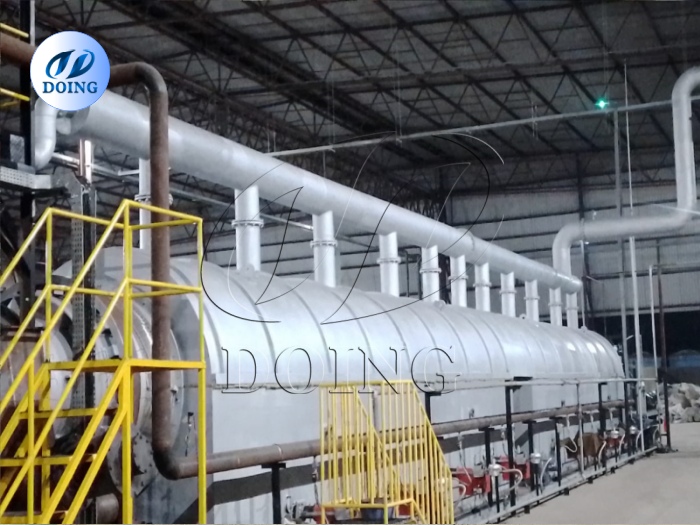 50TPD continuous pyrolysis project in Brazil
Poland | 100 TPD tyre rubber powder full-continuous pyrolysis project
Capacity: 100 TPD (2 × DY-C50 in parallel) / approx. 36,000 t/a
Configuration: European-standard full-continuous cracking line, enclosed micro-negative-pressure system, multi-stage condensation, dust-free carbon black handling, high-standard desulfurisation, denitrification and deodorisation, intelligent automatic control
Note: A benchmark tyre pyrolysis installation in the EU, with emissions, safety and automation meeting European environmental access requirements.
Vietnam | 150 TPD waste plastic pyrolysis project large cluster
Capacity: 150 TPD (10 × DY-15 units in parallel) / approx. 54,000 t/a
Configuration: anti-waxing anti-blocking system, multi-unit parallel condensation, centralized environmental treatment, cluster-level PLC management
Note: One of the largest plastic pyrolysis clusters in Vietnam, operated by a leading local recycler.
The above configurations are indicative only. Actual design must be based on your feedstock analysis, local emission rules and product destination.
To receive a preliminary module list and layout proposal, please provide: (1) feedstock type and daily volume, (2) target products (pyrolysis oil / diesel-grade fuel / carbon black), and (3) local emission requirements. DOING ECO's engineering team will respond with a matched configuration, a recommended single-line or parallel-line arrangement, and a budgetary quotation.
Contact DOING ECO: submit your requirements through the site enquiry form, or reach our overseas engineering team via WhatsApp / WeChat / email listed on the Contact Us page. For investors in markets where we have a registered subsidiary, a resident engineer can also arrange a site call.
As a budgetary envelope only (FOB China, excluding civil works, shipping, installation and taxes): a 50 TPD single line roughly USD 300,000–600,000; a 100 TPD dual line roughly USD 550,000–1,100,000; adding a refining line adds approximately USD 150,000–400,000. Final price depends on reactor count, refining line inclusion, environmental specification and steel price — a firm quotation follows a confirmed configuration list.
Typically 600–2,000 m² for the workshop, depending on whether pre-treatment and the tank farm are housed indoors. A refining line requires additional space. A detailed layout is provided after the module list is fixed.
Around 6–10 operators across two shifts for a full-continuous line with PLC control, assuming automated pre-treatment and enclosed carbon black handling. Manual handling in these sections increases staffing.
On-site mechanical installation typically takes 30–60 days, followed by electrical wiring and hot commissioning; a refining line adds its own phase. Overall expect roughly 1–2 months for a pyrolysis-only line. DOING ECO dispatches an overseas engineering team for installation supervision and commissioning.
Technically possible but rarely optimal: plastics need dewaxing and catalytic conditioning, tyres need robust pre-treatment and discharge systems. Dedicated lines or clearly defined switching rules are recommended.
With secured feedstock and a 24/7 operating plan, yes — higher annual throughput, better energy efficiency and lower labour cost per tonne. With uncertain supply or phased investment, semi-continuous clusters offer more flexibility.
Batch plants load and unload in cycles, suiting small tonnage and low upfront budgets. Continuous plants feed and discharge without stopping, delivering higher annual output and lower per-tonne operating cost — which is why the 50–200 TPD band is almost always configured as continuous or semi-continuous cluster layouts.


Contact DOING experts and learn how we can service your needs.